Borrowing the Double Diamond for Research
When you are new to a topic, it is tempting to jump straight from a broad project idea to the first solution that sounds interesting.
That is how you can spend a semester building something impressive that does not answer a useful question.
I like to borrow the Double Diamond from human-centred design as a simple way to slow that jump down. The idea is to explore widely and then narrow your focus twice: first for the research problem, then for the solution.
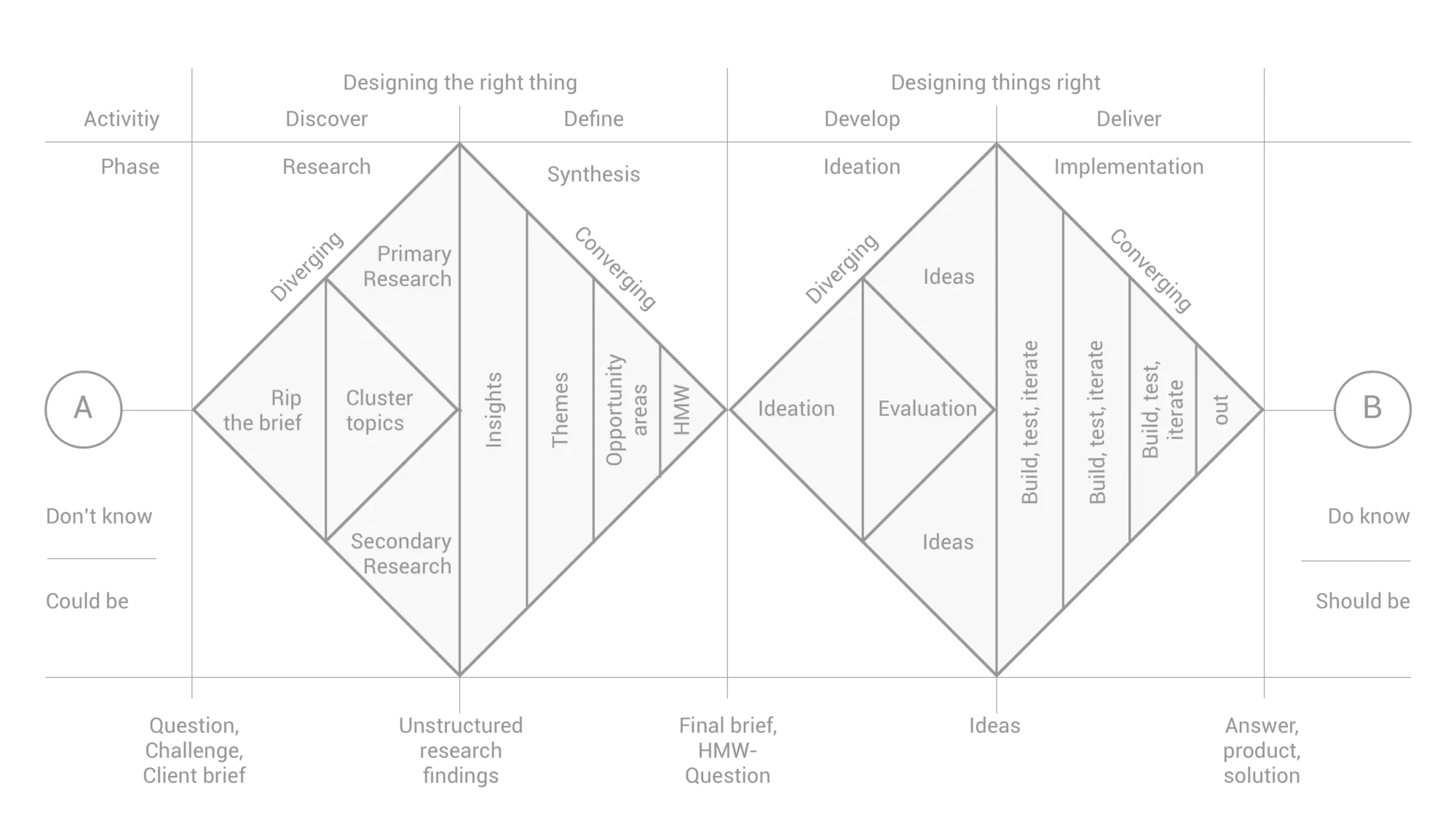
Adapted for research from the Design Council's Double Diamond.
Note
I am using this as a thinking tool, not claiming that it is a complete research methodology.
The first diamond: find the question
A broad topic is not yet a research question. The first diamond helps you understand the problem space before deciding exactly what your project will investigate.
1. Discover: explore the problem
Start broad. At this point, you are trying to understand the area rather than defend a solution you already have in mind.
You might:
- read foundational papers, recent work and useful review papers;
- inspect the existing system, data or workflow;
- speak with users, clients or other people affected by the problem;
- list assumptions, constraints, pain points and things you do not yet understand;
- look at what has already been tried and where it falls short; and
- collect several possible questions instead of committing to the first one.
2. Define: narrow it into a research problem
Now make sense of what you found. Decide which part of the problem is important, answerable and realistic within the time and resources you have.
A useful provisional research question should make it reasonably clear:
- what you are investigating;
- why it matters;
- what uncertainty or gap remains;
- what is inside and outside the scope; and
- what evidence could help answer it.
The second diamond: find the solution
Once the problem is clearer, you can explore how to investigate or address it. The second diamond is where you prototype, compare and test possible approaches.
3. Develop: explore possible approaches
Do not assume your first technical idea is the only option. Consider several ways to answer the question, then test the risky parts early.
You might:
- sketch several system or experiment designs;
- compare possible sensors, algorithms, interfaces or representations;
- build small prototypes rather than one complete system;
- reproduce a baseline from earlier work;
- test the assumptions most likely to make an approach fail; and
- decide what measurements would distinguish one approach from another.
4. Deliver: choose, test and explain
Narrow down to the most useful approach and evaluate it properly. Build the version needed to answer the research question, collect the evidence and explain what the result supports.
“Deliver” does not mean the project must end with a successful product. A negative or inconclusive result can still be useful research when the method is sound, the evidence is clear and the limitations are honestly reported.
It is allowed to loop backwards
A prototype might reveal that your question cannot be answered with the available hardware. A test result might expose a more important problem. You might find a paper that did exactly what you were trying to do, and failed miserably.
When that happens, move back to the relevant stage, update your research log and explain why the project changed direction.
Do not skip the first diamond
If you begin with “I want to use this sensor, algorithm or headset”, you already have a solution. Step back and ask which problem it helps investigate, who the problem matters to and what evidence would show that the idea is actually useful.
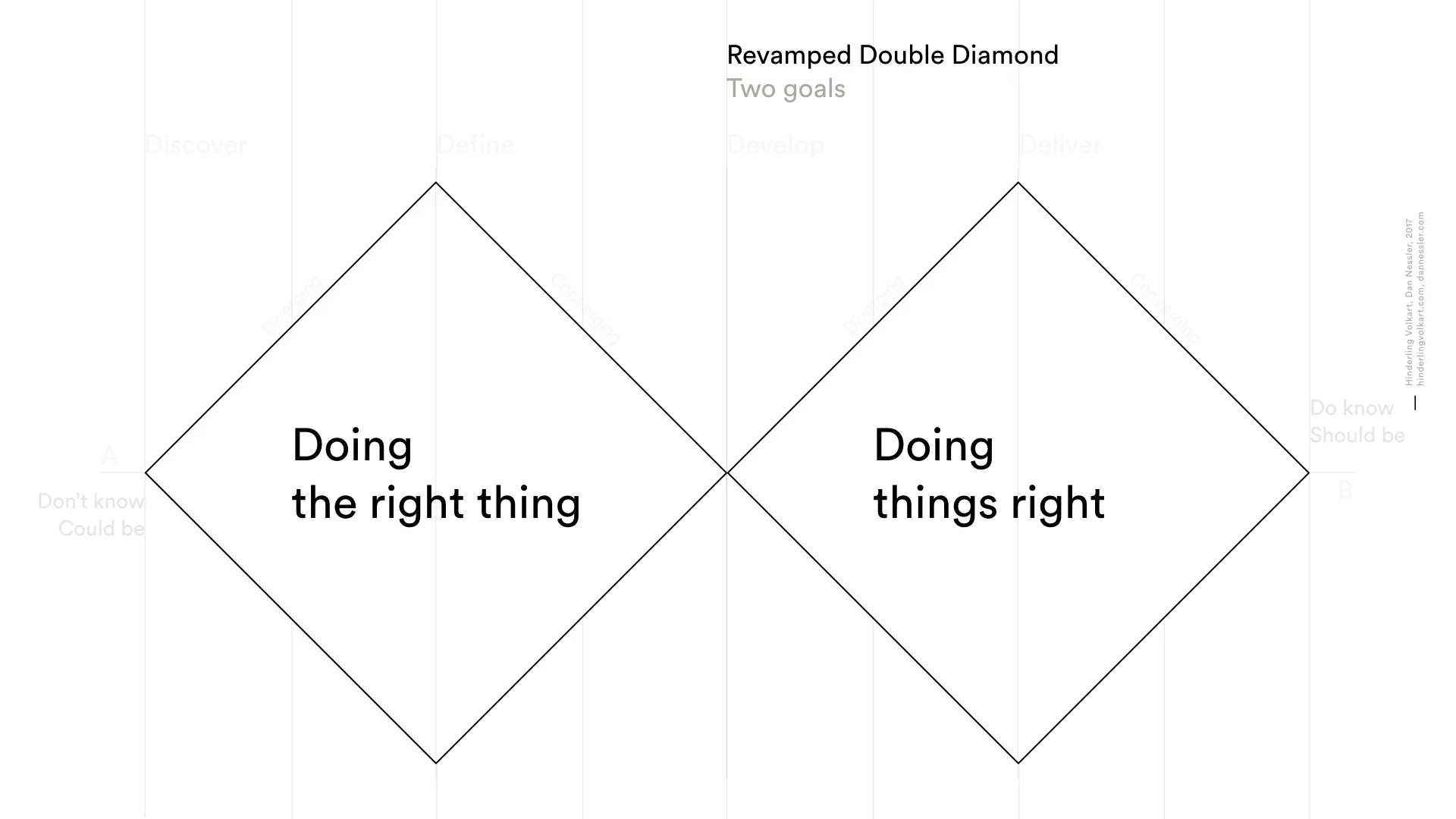
I also really like this simplified version of the Double Diamond by uxdesign.cc. It's much easier to keep it in mind when I work on anything.